
The Leader of all Mevlevis
by Ibrahim Gamard
 |
|---|
About the Mevlevi Order1
The Maqam-i Chelebi, the Hereditary Leader of All Mevlevis2
Mevlevi Movements in the West3
Mevlevi Organizations that Continue to be Independent of the Maqam-i Chelebi's Authority4
An Invitation to a Common Ethic5
An Invitation to Unity6
Bismi 'llâhi 'r-raHmâni 'r-raHîm.
The Mawlawî (Mevlevi) Order is the continuation of the spiritual teachings and practices of Hazrat-i Mawlânâ (Mevlânâ) Jalâluddîn Rûmî, his descendents, and his followers for over 700 years. Due to legal restrictions on organized sufi activity in Turkey during the past hundred years, the Mevlevi tradition has become seriously weakened.
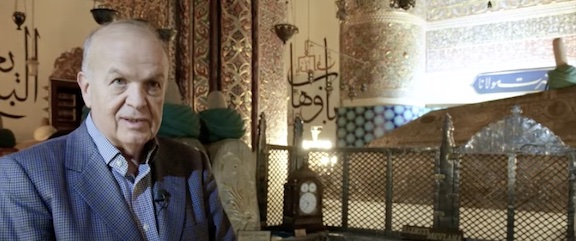
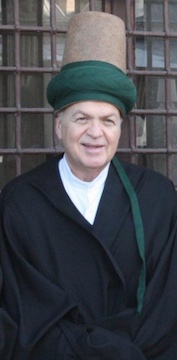
In today's world of ready electronic information, there are quite a number of Mevlevi or Mevlevi-like organizations that have websites and that have various claims of authority. This makes it difficult for individuals using the Internet to determine which organizations have legitimate authority and which ones do not. As a result, it is more difficult for the auhentic Mevlevi tradition to become established in the West in accordance with traditional spiritual practices, teachings, and ethics. The purpose of this article is to clarify that only the "Chief Chelebi" or Maqâm-i Chelebi, the direct descendent of Mawlânâ Jalâluddîn Rûmî, has the authority to decide who is a legitimate and authorized Mevlevi leader and who is not. The current Maqâm-i Chelebi is Fârûk Hemdem Çelebi of Istanbul, Turkey (below). He was born in Aleppo, Syria in 1950.
 |
|---|
Fârûk Çelebi Efendi is President of the International Mevlana Foundation (in Turkish, "UluslarasI Hz. Mevlânâ Vakfi"), centered at the present time in Istanbul and Konya. All legitimate Mevlevi shaykhs must be affiliated with him through this central organization. Unfortunately, some Mevlevi leaders have chosen to ignore Chelebi Efendi's authority--or, in some cases, to give some amount of verbal affirmation with no real cooperation or obedience. This article makes a plea for unity for the sake of strengthening the overall soundness of the Mevlevi tradition, especially in the West.
1About the Mevlevi Order
The early organization of Mevlevi activities was supervised by Mawlânâ Rûmî's first successor, Chelebi Husâmuddîn for the first ten years, and then by an advanced disciple of Rûmî's, Shaykh Karîmuddîn Baktamur for another eight years. After the death of the latter, Rûmî's son, Sultân Walad, became the full leader. In spite of his reputation of being the founder of the Mevlefvi Order, he was apparently content for others to bear the administrative duties and the training of disciples. He was strongly committted to producing manuscripts that accurately preserved his father's words as well as composing his own substantial poetic works: three mathnawî's, one dîvân, and one prose work of discourses. Chelebi Husâmuddîn supervised the building of the first shrine that contained the graves of Rûmî, his father, and Shaykh Salâhuddîn. He supervised, together with Sultân Walad, the scribe who wrote the Konya manuscript of the Mathnawî. He oversaw that stipends for Rûmî's widow (Kera Khâtûn) were paid regularly, as well as for the Mathnawî reciter, the Qur'ân reciter, the disciples, guests, travelers, and so on. And he appointed shaykhs to go to other cities and teach Rûmî's legacy of teachings. Later, Rûmî's grandson, Ûlû `Ârif Chelebî appointed many more shaykhs to other cirties. Eventually, there were 114 tekke [takyâ] (monastery-like) buildings or building complexes established throughout the Ottoman Empire--including ones in Belgrade, Athens, Cairo, Mecca, Baghdad, Damascus, and Tabriz. Central authority remained in Turkey at the most important tekkes, especially in Konya. After the collapse of the empire, following defeat in World War I, the new Turkish government of Ataturk declared all sufi organizations [tariqats] in Turkey illegal in 1925. All surviving Mevlevi tekkes were closed down. Some were made into mosques and a few into museums, such as the main tekke (or Mevlevihane) in Konya (where Mawlânâ Rûmî is buried) and the Galata tekke in Istanbul.
Since 1925, Mevlevi activity has been very restricted and private in Turkey. There have been many obstacles, so that the provision of Mevlevi dervish training to each generation has been limited. Starting in 1953, public performances of the Mevlevi Samâ` (Sema, in Turkish, the famous Whirling Prayer Ceremony) have been permitted by the Turkish government in Konya, first in the public library, then in gymnasiums, then in a sports stadium, and presently in a large building built for Sema performances. Thousands of people come from all over the world in mid-December each year to buy tickets and see the performances that are organized by the Ministry of Culture and Tourism. Public performances of Sema have also occurred for many years at the Galata Mevlevihane (now called a museum) in Istanbul. Another Mevlevihane in Istanbul, called the YenikapI tekke, that was burned down in 1961, has been rebuilt but is used by a university. It once again has a separate Sema hall [semahane] for Sema performances.
In sum, the sacred whirling prayer ritual of the Mevlevis has been largely taken over by the Turkish Government for the purpose of promoting tourism. The Government has little interest in lifting restrictions on the Mevlevi tradition: all it has wanted from the Mevlevis during past decades is to provide good musicians and whirlers (semazens) for Sema. At the present time, excellent musicians have been trained at schools and universities in Konya to play classical Mevlevi music, and there have been new generations of trained whirlers as well. As a result, there is a smaller percentage of musicians and whirlers who view themselves as Mevlevi (or who have had any additional Mevlevi training) than in the past. This matters little to the Turkish Government, which has tended to view Sema as a form of "traditional Turkish folk dancing."
The Mevlevi Sema is more accurately called the "Semahane Ceremony" because it is only authentic to the extent that it is done in the Sema hall [semahane, samâ`-khâna] of a Mevlevi tekke, is led by a shaykh or Sema leader [pôstneshîn] appointed by the current Maqâm-i Chelebi, and is done by musicians and whirlers [semazens] who have genuine Mevlevi initiation, training, and education and who are all praying "Allâh, Allâh!" silently in unison during the Ceremony. And it should be emphasized that the Sema is only one part of the spiritual treasury of the Mevlevi tradition.
2The Maqâm-i Chelebi, the Hereditary Leader of All Mevlevis
For more than 700 years the highest authority for all Mevlevi centers has been a direct descendent of Mawlânâ Jalâluddîn Rûmî, called "Hazrat-i Chelebi" ("His Holiness the Chelebi") or "Maqâm-i Chelebi" ("the Exalted Rank of the Chelebi") or "Chelebi Efendi." These are also descendents of Mawlânâ's grandsons. This centralized authority, based in Turkey, remained intact over the centuries and over distance--whether a Mevlevi tekke was in Turkey, Egypt, Bosnia, Greece, or Arabia. The word "chelebi" is a Turkish word that has been long used to mean a well-bred, educated, and refined gentleman. Because it also refers to the Chelebi family (spelled in Turkish as "Çelebi") who are the direct descendents of Mawlânâ; it also means "the leader of the Mevlevis."
Traditionally, the Maqâm-i Chelebi [Makam-I Çelebi or Makam-Çelebi in modern Turkish] inherits the right to be the chief shaykh and pôstneshîn [Turkish: postneshin] (leader of the Samâ`/Sema, or Whirling Prayer Ceremony) at the Mevlevi center [tekke] in Konya], where Mawlânâ Rûmî is buried. Each Maqâm-i Chelebi successor was given Mevlevi dervish training at another Mevlevi center prior to becoming the shaykh and postneshin at the Konya center. Succession is patrilineal: priority is given to the oldest son of the prior Maqâm-i Chelebi, another son (if the eldest is unwilling or unable to fulfill the responsibilities, or lacks support for being chosen), a son of the Chelebi who preceded the prior Maqâm-i Chelebi, a brother of the prior Maqâm-i Chelebi, another grandson of the Chelebi who preceded the prior Maqâm-i Chelebi, and so on. During the late Ottoman Empire, the Mevlevi Order was so enmeshed with the government that the Sultan of the Empire was involved in the approval for succession. During the modern era, the next Maqâm-i Chelebi is chosen by the members of the Chelebi family.
It is not necessary that the Maqâm-i Chelebi be gifted with spiritual advancement and exceptional spiritual wisdom. That is needed for the number two leader of the Mevlevis: the Spiritual Director of the Mevlevi Tariqat, the chief spiritual guide [murshid] of all Mevlevi shaykhs and followers who is called the Sar-i Tarîq ["Sertarik," in modern Turkish], who is appointed by the Maqâm-i Chelebi. Instead, the Maqâm-i Chelebi has primarily an administrative authority to make important decisions to protect the welfare of the Mevlevi organization and the Mevlevi tradition and to further its growth--decisions that also involve Divine guidance.
Although it is for the shaykhs to decide how and what Mevlevi teachings and traditions they teach (normally under the guiding authority of the Ser-i Tarik, or Chief Shaykh), the Makam-i Chelebi has the right to be informed about the content of what the shaykhs are teaching (which is part of his job to make sure that Mevlevi traditions are being kept up).
The present hereditary leader of all Mevlevis, the Maqâm-i Chelebi is Faruk Hemdem Çelebi [Arabo-Persian spelling: Fârûq Hamdam Chalabî], the son and successor of his father (Jelaluddin M. Bâqir Chelebi, who died in 1996--see the "Chelebi Family Website" at www.mevlana.net); he is the current Hazrat-i Chelebi, the 22nd generation great-grandson of Mawlânâ Jalâluddîn Rûmî, and the 33rd Maqâm-i Chelebi (with Mawlânâ Rûmî counted as the first).
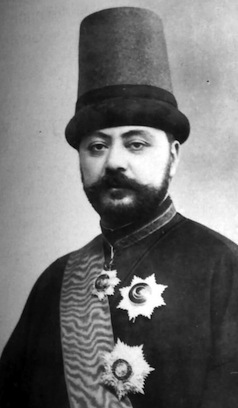
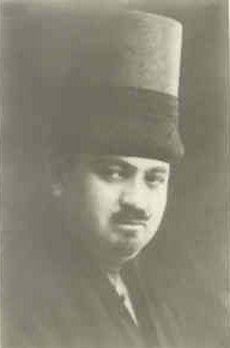
Chelebi Efendi's great-grandfather, Abdul-Halim Chelebi (died, 1925), was the last Grand Chelebi of the Mevlevi Order during the Ottoman Empire until the dissolution of the empire after World War I and the law of 1925 (Tekke ve Zaviye Kanun) that made all sufi organizations illegal (a law that continues to the present day). His grandfather, the 31st Maqâm-i Chelebi was Mehmet Bâqir Chelebi (born 1901 in Manisa Mevlevihane, died, 1944); he lived in Aleppo, Syria and was the international leader of all Mevlevi lodges outside of Turkey from 1925 until 1937, when he was expelled from Syria. Celebi Efendi's great-grandfather (below, left) and grandfather (below, right) were buried next to each other at YenikapI Mevlevihanesi in Istanbul.
 |
 |
|---|
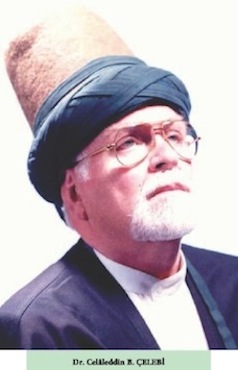
Chelebi Efendi's father (below, left), the 32nd Maqâm-i Chelebi, was Jelaluddin M. Bâqir Chelebi who was born in Aleppo, Syria, was awarded an honorary doctorate, died in Istanbul in 1996, and was buried in Konya.
 |
|---|
It is the Mevlevi tradition that no one may have the title of "Mevlevi shaykh" (given permission to wear the "shaykh's turban sash" [dastâr]) unless this is authorized by the current Chelebi Efendi: in the case of a new shaykh, with a written permit [ijâzat] signed by the Maqâm-i Chelebi for the rank and responsibility of being a shaykh; in the case of someone who was given a permit [ijâzat] for being a shaykh by the previous Maqâm-i Chelebi, the acceptance of a new pledge [bay'at, bey'a] of allegiance to the new Chelebi Efendi's authority.
This means that someone who has been chosen by a Mevlevi shaykh to be his "representative" or "deputy" [khalîfa, halife] (and authorization for this is must also be approved by the Maqâm-i Chelebi), a rank that involves some teaching authority as delegated by his shaykh, cannot automatically become a Mevlevi shaykh after his Mevlevi shaykh's death. He must have the authorization of the Maqâm-i Chelebi to become a shaykh. And someone who has been given the title of "halife" by a Mevlevi shaykh should be careful not to conclude that this is the same thing as being "made a shaykh" (in the same way that there may be little difference between being a "halife" and a "shaykh" in some other Turkish sufi orders). Similarly, titles of "shaykh" or "shaykha" or "pôstneshîn" within independent Mevlevi organizations are also not legitimate in the Mevlevi tradition.
Since all Mevlevi shaykhs remain as such by continuing to be accepted by the current Chelebi Efendi, this means that their rank of shaykh may be taken away if they lose acceptance by the current Chelebi Efendi, such as by unacceptable violations or innovations to Mevlevi tradition or very serious ethical failings. Such individuals may be asked to return their Mevlevi turban sash [destar] and ijâzat (signed permit) to the Maqâm-i Chelebi. This also means that if the holder of the rank of Makam-i Çelebi dies, then all previously accepted Mevlevi shaykhs should make renewed pledges of loyalty [bay`at, bey'a] to his successor from the family of Mevlana, the new Chelebi Efendi--pledges that must be accepted--in order to remain approved as Mevlevi shaykhs.
The current permit for being a Mevlevi shaykh is called simply, "permit document" [icazetname] thereby avoiding the word "shaykh," one of the titles used in sufi organizations that was made illegal under the 1925 law. The correct name used in Ottoman times was "shaykhhood document" [meshihiname, mashîkhî-nâma]. This authorization was written in Persian during earlier times; subsequently it has been written in Ottoman Turkish.. In recent decades, a permit has been given to be a Mesnevi teacher, not a shaykh; however, the authorization given to Mesnevi teachers is the same general "permit document" [icazetname] given to newly authorized shaykhs, who have been trained in the Whirling Prayer Ceremony (Sema).
The Masnavi teacher [Mesnevihan] was also permitted to wear the same turban sash [destar] as a shaykh; this was also permitted to a shaykh's deputy [halife], with permission of the Maqâm-i Chelebi. In Ottoman times, a Mevlevi dervish who was a direct descendant of the Prophet Muhammad's daughter's sons [called: sayyid] or who was a direct patrilineal descendent of Mawlânâ Rumi were also permitted to wear the turban sash. Mevlevis who wore the turban sash were accorded high deference according to their rank. However, the person of significance who had the rank of shaykh was the one authorized to be in charge of a tekke.
The title of "Dede" is no longer officially used. However, informally, some sheikhs have been (and are currently) affectionately called that. In Mevlevi tradtion, a Dede is one who has completed a "retreat" [chille] of 1,001 days in a Mevlevi tekke. The last living person (as of 1975, per Friedlander's book) to complete the retreat in Konya was Osman Dede, who was also called "Chille Dede."
During the leadership of Mehmet Bâqir Chelebi (who lived in Aleppo, Syria from about 1925 until 1937 when he was barred from returning to Syria after visiting Turkey, and who died in 1944), an unknown number of individuals may have been appointed a Mevlevi shaykhs in lodges outside of Turkey, as needed. The following were regarded as Mevlevi shaykhs and Mesnevi teachers; information about how they were authorized is not currently available:
1) Midhat Bahâri Beytur Efendi of Istanbul (1879-1971, Masnavi reciter [Mesnevi-han, Masnavî-khwân] at KasImpasha Mevlevihane, student of Hüseyin Fahreddin Dede (died 1911, the last sheikh of Beshiktash Mevlevihane and the first shaykh of Bahariye Mevlevihane; Midhat Bahari was authorized as a shaykh in 1924, the last Mevlevi to be authorized as a shaykh prior to 1925; he was the first Mevlevi shaykh allowed to lead Sema in the "Sema revival" period that began in 1956)
2) Tâhir Olgun Efendi (Tâhir'ül Mevlevî) of Istanbul (1887-1951), student of Esad Dede (d. 1911), authorization [ijâzat] for being a Mesnevi teacher [Mesnevi-hân, Masnavî-khwân] (1893), became a Dede (1898)
3) Abdülbâkî GolpInarlI Efendi (1900-1982, an important Mevlevi scholar, student of Hüseyin Fahreddin Dede)
During the leadership of Jelaluddin Bâqir Chelebi (who lived in Istanbul, and died in 1996), a number of individuals were authorized and given a written permit [icazet, ijâzat] to be Mevlevi shaykhs or Mesnevi teachers. (Süleyman Loras is reported to have described a secret meeting during very repressive times when the anti-Sufi laws were harshly enforced, when he was appointed together with Selman Tüzün and Enver Çelebi)
4) Ahmed Gavsi Baykara Efendi of Istanbul (1902-1967, son of the last shaykh of the YenikapI Mevlevihane, Abdülbâkî Dede)
5) Enver Turunch Chelebi Efendi, born into a branch of the Konya Çelebi family that was established in Afyonkarahisar
6) Münir Öztorun (Münir Çelebi) Efendi (died 1972), born into a branch of the Konya Çelebi family that was established in Afyonkarahisar, authorization [ijâzat] for being a Mesnevi teacher [Mesnevi-hân, Masnavî-khwân]
7) Süleyman Hayati Loras Efendi (1904-1985, pictured in Friedlander's "The Whirling Dervishes," 1975)
8) O. S. Resûhi Baykara Efendi of Istanbul (1913-1989, son of the last shaykh of the YenikapI Mevlevihane, Abdülbâkî Dede)
9) Selman Tüzün Efendi of Istanbul (1905-1995, grandson of Hüseyin Fahreddin Dede, the first shaykh of the Behariye Mevlevihane; also a Sema leader, or pôstneshîn, depicted in Friedlander's book, "The Whirling Dervishes," 1975)
10) Andaç Arbash Efendi of Ankara (1932-2003, whose teacher was Abdülbâkî GolpInarlI)
11) Abô 'l-Qâsem Tafazzolî Efendi of Tehrân (died, 2004, authorization [ijâzat] for being a Mesnevi teacher [Mesnevihan, Masnavî-khwân])
12) Shefik Can Efendi of Istanbul (1910-2005, a Mesnevi teacher, or Mesnavihan [Masnavî-khwân], who dedicated his last decades translating Mawlânâ's poetry into contemporary Turkish from the original Persian texts; his teachers were Tâhirü'l-Mevlevi--Tâhir Olgun, a Mesnevihan (with whom he began studying in 1935 and from whom he received a written authorization [icazet-name] to be a Mesnevihan) who died in 1951--and Midhat Bahâri Beytur who died in 1971)
13) Hüseyin Top Efendi of Istanbul (b. 1933, a Hâfizu 'l-Qur'ân, his teacher was Midhat Bahâri Beytur), he led a Sema group for years at Galata Mevlevihana.
14) Omer Tughrul Inancher Efendi of Istanbul (1946-2022), recent leader of the Helveti-Jerrahi sufi order; starting in 1993, he was the director of a Turkish Ministry of Culture music group of musicians and has been the Mevlevi leader (postneshin) of a Sema group in Istanbul consisting of Jerrahi dervishes trained as semazens).
15) Nail Kesova Efendi of Istanbul (b. 1936, who was a semazen during the Sema Revival period, whose teacher was Ahmet Bican Kasapoglu, and who led a Sema group for many years at Galata Mevlevihane)
16) Kabir Helminski Efendi of the USA (b. 1947)
During the leadership of the present Chief Chelebi, Fâruk Hemdem Chelebi (of Istanbul), the following have been authorized and given a written permit [icazet, ijâzat] to be a Mevlevi shaykh or a Mesnevi teacher (at some point, he decided that both permits were similar, so that a Mesnevi teacher was allowed to lead Sema as a postneshin):
17) Shemsi YIlmaz SusamIsh Efendi of Sivas (b. 1937), one of the oldest semazens during the Sema revival period, since the age of fifteen; later a postneshîn (he said that he was given verbal icazet in the 1990's from Jelalettin Chelebi Efendi to lead Sema); the son of Mehmet Dede, also known as Sivas Dede (d. 1978), whose photo appears in Friedlander's 1975 book.
18) Süleyman Wolf Bahn Efendi of Germany (b. 1944)
19) Hüseyin Peter Cunz Efendi of Switzerland (b. 1949)
20) Mürsel Michaël Derkse Efendi of The Netherlands (1953-2020)
21) Emin IshIk Efendi of Istanbul (1936-2019; authorization [ijâzat] for being a Mesnevi teacher [Mesnevihan]; a Mesnevi teacher in Istanbul, whose teacher was Midhat Bahâri Beytur Efendi; he was also a Hâfizu 'l-Qur'ân)
22) Kadri Yetish Efendi of Istanbul (b. 1931, his grandfather was a Mevlevi, his Mevlevi teacher was Midhat Bahâri Beytur, he led a Sema group for years at Galata Mevlevihane (together with Huseyin Top Efendi, and then indepently) and later at YenikapI Mevlevihane.)
23) Nadir KarnIbüyükler Efendi of Konya (b. 1959, he wass born and raised in Konya, his father was a Kadiri shaykh, he was a semaaen during the Sema Revival period, he has a Sema group and during the past few years he has been leading Sema in Konya on Thursday nights (except during rainy and cold weather) in the outdoor amphitheater on the grounds of the Mevlana Museum).
24) NâsIr Abdülbâkî Baykara Efendi of Istanbul (b. 1948, who grew up in a Mevlevi family, whose father was O. S. Resûhi Baykara Efendi, and whose grandfather was the last shaykh of YenikapI Mevlevihane).
25) Hüseyin Erek Efendi of Istanbul (b. 1960; a Hâfizu l-Qur'ân, one of the leaders [imâm] of a large mosque, the leader of a Sema group, and a Mesnevi teacher)
26) Ibrahim Gamard Efendi of the USA (b. 1947)
27) Mohammad Bordbâr Efendi of Tehrân (b. 1949; authorization [ijâzat] for being a Mesnevi teacher [Mesnevihan], a scholar and Mesnevi teacher in Iran who has been writing a commentary on the Masnavi for many years)
28) Fahri ÖzçakIl Efendi of Konya (b. 1961, a semazen and then a semazenbashI for the Turkish Republic's Ministry of Culture and Tourism [Konya Türk Tasavvuf Müzighi Toplulughu, 1990], designated by the Ministry as the primary postneshin of the Ministry's Sema group, depicted in Friedlander's book, "The Whirling Dervishes," 1975)
29) Mustafa Gustavo Martinez Efendi of the USA (Miami and Bogota, Columbia)
30) Bahâüddin Tâhâ Hidâyetoghlu Efendi of Konya (b. 1975, a physician who grew up in a Mevlevi family)
31) YIlmaz Kafadar Efendi of Istanbul (a surgeon, a former semazen, and a long-time supporter of Jelaluddin M. Bâqir Chelebi Efendi)
32) Ahmet Sami Küçük Efendi of Konya (b. 1969, a semazen and then a semazenbashI for the Turkish Republic's Ministry of Culture and Tourism [Konya Türk Tasavvuf Müzighi Toplulughu, 1990])
33) YIldIrIm Ekin Efendi of Amsterdam, The Netherlands (b. 1970 in Eregli, Turkey near Konya)
34) Abdul Aziz Malcolm Dart Efendi of Melbourne, Australia (b. 1953, England; leader of the Mevlevi Order of Australia since 1986)
35) Mim Kemâl Öke Efendi of Istanbul (b. 1955, professor of political science)
36) Nezih Chetin Efendi of Istanbul (b. 1961, starting in 1993 he was the semazenbashi of the Helveti-Jerrahi Sema group, then appointed in 2016 as the Mevlevi successor (halife) of the Sema group leader (postneshin), Tughrul Inancher Efendi, and then appointed in May 2018 as the Mevlevi leader (postneshin) of the Sema group.)
37) Mehmet Veysi Dörtbudak Efendi of Manisa (b. 1962; formerly a halife of Nadir Karnibuyukler Efendi of Konya; he teaches Mesnevi online).
38) Ahmet Coshar Efendi of Mersin (b. 1962; formerly a halife of Nadir Karnibuyukler Efendi of Konya; icazet for postneshin).
39) Ismail Fenter Efendi of Konya (b. 1955; an American who lives in Konya; he has advanced degreess (MA, MDiv, MTh, MM); he teaches Mesnevi to an online group; icazet for Mesnevihan).
40) Ahmet Chalishir Efendi of Konya (b. 1966; Hafiz; icazet for postneshin).
41) Serkant Dervishoglu Efendi of Istanbul (b. 1981); formerly a halife of Kadri Yetish Efendi of Istanbul;icazet for postneshin).
42) Enes Durceylan Efendi of Istanbul (b. 1994; formerly a halife of Nadir Karnibuyukler Efendi of Konya; icazet for postneshin).
The Turkish government's Ministry of Culture and Tourism has sometimes cooperated with the International Mevlana Foundation (see below) and sometimes ignored it. For example, in 1990 it appointed Mustafa Holat (the son of a Konya semazen) to be the Postneshin of the Ministry's Sema group in Konya; he was never authorized by Jelaludin Chelebi or Fâruk Hemdem Chelebi to be a Mevlevi shaykh. Mustafa Holat retired in 2011 and was succeeded by Fahri ÖzçakIl (also the son of a Konya semazen), who was also appointed by the Ministry to be the next Postneshin; fortunately, he was also authorized by Fâruk Hemdem Chelebi Efendi to be a Mevlevi shaykh; this settled the conflict of authority issue. Recently, however, the Ministry of Culture and Tourism, through its Istanbul State Turkish Music Research Group, Department of Sufism, Wisdom, and Arena Practices [Tasavvuf, Irfan, ve Meydan Meshkleri] appointed Mehmet FatIh ChItlak (formerly a member of the Halveti-Jerrahi Order of Sufism, who broke away some years ago and formed an independent Sema group with himself as (an unauthorized) postneshin. This current appointment was made in September 2020, following a type of civil service exam. Once again this ignored Fâruk Hemdem Chelebi's sole authority as the Makam-Chelebi in Mevlevi tradition and history to authorize Mevlevi shaykhs.
In addition to appointing new Mevlevi shaykhs, Fâruk Hemdem Chelebi Efendi has worked hard to gain understanding and support from the Turkish Government for what remains of the Mevlevi tradition in Turkey. He has gone frequently to the capital, Ankara, to meet with officials of the Ministry of Culture and Tourism (and his sister, Esin Chelebi Bayru has attended many such meetings in his absence). As President of the International Mevlana Foundation, his leadership has resulted in a number of important achievements, including the following:
(A) Organizing the International Mevlana Foundation, in Istanbul, from the beginning, along the lines suggested by his father before he died (in 1996).
(B) An official request (subsequently accepted) that "the Sema (Whirling) Ceremony be safeguarded and preserved as well as the ceremonial whirling halls called Semahanes where these ceremonies were performed together with the Sacred Kitchens and Dervish Cells of the historical Mevlevi Dervish Lodges (Mevlevihanes) which were used for the oral transmission training of the Sema and music in preparation for the performances of this Whirling Ceremony." The request consists of scholarly information about the Ceremony (compiled by Dr. Bârihüdâ TanrIkorur, Prof. Dr. Walter Feldman, and Reha Saghbash, and others), including musical notations and translations of some musical compositions for the Sema, many pages of historical photographs, and other interesting appendices. Totalling about 275 pages, primarily in English, the request is entitled, "Candidature File of the Mevlevi Sema Ceremony known historically as the Mevlevi Âyîn-i Sherîf or Sema Mukabele-i Sherîf, The Mevlevi Sacred Rituals or Sacred Encounter of Whirling For UNESCO's Proclamation of 'Masterpieces of the Oral and Intangible Heritage of Humanity' Prepared by the International Mevlana Foundation for presentation by the Republic of Turkey Ministry of Culture and Tourism Ankara, Turkey October 2004".
(C) An official request, that originated from the International Mevlana Foundation, that the year 2007 be declared by UNESCO as the international "Year of Rumi" (subsequently accepted), in honor of the 800th year since the birth of Mevlana Rûmî.
(D) After the "Year of Rumi" was proclaimed, the three participating nations of Turkey, Iran, and Afghanistan agreed to hold international conferences about Mevlana/Mawlana during 2007. The International Mevlana Foundation was a co-sponsor of the international conference held in Istanbul and Konya during May 2007. At the opening ceremony in Istanbul, Fâruk Hemdem Chelebi Efendi and his sister (Esin Chelebi Bayru) were present when a medal from UNESCO (having to do wth the Candidature File for preservation of the Sema) was presented to the Turkish Government Minister of Culture.
(E) Fâruk Hemdem Chelebi Efendi was a consultant for a documentary film entitled "Mevlana Jelal ud-din Rumi" that was filmed in five countries (including Turkey, Afghanistan, and Germany). The film, directed by Tulay Akça and produced by Turkish Radio and Television, was first shown at the headquarters of UNESCO in Paris in April of 2007, as part of the commemorations that occurred during the "Year of Rumi".
(F) A Sema tour to fourteen cities in the United States and Canada, in September 2007. The Sema group was led by one of the International Mevlana Foundation postneshins, Kadri Yetish Efendi of Istanbul. Esin Çelebi Bayru gave an introductory speech about Mevlana and the Mevlevi tradition prior to each Sema.
(G) The restoration (completed) of the largest Mevlevi center in Istanbul, the YenikapI Mevlevihanesi, using matching construction materials and even paint color based on the original architectural plans. This restoration would not have been accomplished without the untiring efforts of Fâruk Hemdem Chelebi Efendi and his sister (Esin Chelebi Bayru). Although the International Mevlana Foundation had proposed that the Mevlevihane become an international institute where ongoing classes could be given to train Mevlevi musicians, whirlers (semazens), artisans, and scholars, the Turkish government decided that it would best be used to house a university. The separate Sema hall building, however, is used by Sema groups for performances.
(H) A Sema tour to several colleges in the United States (including Yale University), the Metropolitan Museum (New York City), and the National Cathedral (Washington, D.C), in October 2008. The Sema group was led by one of the International Mevlana Foundation postneshins, Nadir KarnIbüyükler Efendi of Konya. Fâruk Hemdem Chelebi Efendi gave an introductory speech about Mevlana and the Mevlevi tradition prior to each Sema.
(I) The publication of a bilingual book (left columns in Turkish, right columns in completely translated English) that contains many good features of the above mentioned "Candidature File" (which had the limitation of being organized according to a UNESCO format and questionaire), as well as new sections such as about Mevlevi history and the Chelebi family, and a glossary of terms. Totaling 436 (large) pages, it is entitled, "YüzyIllar Boyu Mevlâna ve Mevlevîlik, Mevlana and Mevlevi Order Throughout Centuries", Istanbul, 2008. It was published jointly by the International Mevlana Foundation and the Republic of Turkey Ministry of Culture and Tourism. It contains a preface by Fârûk Hemdem Chelebi and has detailed articles by Emin IshIk (Mevlana and the Mevlevi Order), Bekir Reha Saghbash (Mevlevi Music), and Ekrem IshIn (the Mevlevi Order and Its Social History). The book was edited by Esin Chelebi Bayru and Bekir Reha Saghbash.
(J) A Sema tour to a number of cities in the United States, in February 2009. The Sema group was led by one of the International Mevlana Foundation postneshins, Fahri ÖzçakIl Efendi of Konya. Fâruk Hemdem Chelebi Efendi gave an introductory speech about Mevlana and the Mevlevi tradition prior to the Sema in Miami, Florida.
(K) The opening of the Konya branch of the International Mevlana Foundation in May 2011, due to the efforts of Esin Chelebi Bayru. This is a small building a short distance behind the exit turnstiles of the Mevlana Museum, Esin Chelebi has her office there, Nâdir Efendi presides as Shaykh there most afternoons, and visitors from many countries are welcomed.
(L) The awarding to the International Mevlana Foundation of Istanbul by the Turkish Institute of Patents and Trademarks in July 2013 of the rights to a number of Mevlevi terms: Mesnevi, Mevlana, Mevlevi, Mitrip Heyeti, Rumi, Sema, Ayin-i Sherifi, Semahane, Semazen, Sheb-i Arus, & Shems-i Tebrizi. This means, for example, that in the future a legal entity such as a restaurant cannot acqquire brand rights to the name "Semazen Kebapchi." However, the ruling does not affect past registered and protected brand names. For example, rights to the name "Mevlana University" were given in the past. However, an application for rights to the name "Mevlana University Rectorate" and "Ashk-i Mevlana" [Love of Mevlana] were denied. A decision on some other Mevlevi terms, such as "Destar-i Sherif," "Sikke-i Sherif," and "Tennure" has not been made yet. The request for rights to the name "Shems" was denied, because it has the generic meaning of "sun."
(M) A Sema tour to Bogota, Columbia and two other cities, in March 2014. The Sema group was led by one of the International Mevlana Foundation postneshins, Nadir KarnIbüyükler Efendi of Konya. Fâruk Hemdem Chelebi Efendi gave an introductory speech about Mevlana and the Mevlevi tradition prior to each Sema. There was a Sema tour (same group) to Milan and Rome (the Vatican), Italy in September 2014, as well as a Sema tour to Sidney, Australia in October 2014.
(N) A press conference in Istanbul in December 2014 in which Fâruk Hemdem Chelebi Efendi and some of his Mevlevi Shaykhs gave speeches about the commercialization of Mevlevi whirling (such as hiring individual semazens to whirl at weddings, in restaurants, and hotel lobbies; an increasing number of imitation Sema groups unconnected to Mevlevi lineage) and the name of Mevlana Rumi (such as "Mevlana Kebab" restaurant), and about the need for protection by the Turkish government from these and other corruptions.
 |
|---|
3 Mevlevi Movements in the West
Out of a larger number of efforts to spread the Mevlevi tarîqat to the West, two cases are mentioned here as examples that led to the training of Westerners to do Mevlevi Sema, but little emphasis on other important components of the Mevlevi tradition.
Starting in the early 1960's the majority of Europeans who were interested in the Mevlevi tradition were students of Gurdjieff's esoteric teachings. Somehow, a number of students of these teachings have had a tendency to believe that the origin of Gurdjieff's "sacred dances" was connected to the Mevlevi tradition. Rusuhî Baykara Efendi was invited to London in order to teach Sema at Colet House (where The Study Society had been founded in 1951 by the successor of P.D. Ouspensky, Francis C. Roles). He first went to London in 1963 and taught Sema. Subsequently, he was given permission by Jelaluddin Çelebi Efendi to initiate Dr. Roles to be a Mevlevi shaykh (after some disagreement among Mevlevi leaders about authorizing a non-Muslim). A promise was made to return the green turban sash (destar) after the death of Dr. Roles; this was done. However, Dr. Roles had appointed a successor (whom he called "second sheikh") whose successor is the current "Sheikh" of the Sema at Colet House. Sema has been taught there ever since, faithfully as it was taught in 1963. Masnavi classes have been taught there, but little else of Mevlevi traditions; as a result, the teaching of Sema is oddly isolated from other teachings at Colet House. Two years prior to the introduction of Sema there, Dr. Roles adopted Advaita Vedanta as his spiritual path and this has been the predominant spiritual orientation of the Study Society since.
After the 31st Maqâm-i Chelebi (Mehmet Bâqir Chelebi) died in 1944, his son and successor Jelaluddin Bâqir Chelebi continued to live in Aleppo, Syria, where his older children were born. In the early 1950's, Jelaluddin Chelebi moved his family to Istanbul. About 1962, he authorized Süleyman Hayati Loras to be a shaykh in Konya. Every year Süleyman traveled to Istanbul during the lunar month of the Ramadân fast in order to cook for Jelaluddin Chelebi, his family, his sheikhs, and guests. For a number of years, Süleyman lived with his family near the Konya Mevlevihane where he cooked and served food in a small kitchen for the poor during difficult times in Turkey. Also, he cooked meals for the guards who worked in the Mevlana Museum. Years later, after he became a Sheikh, his house in another part of Konya became the destination of visitors from many countries.
In 1976, Süleyman Loras came to America for the first time and taught and led the Sema ceremony, after being invited to visit Los Angeles by an English Sufi, named Reshad Feild, whom he had met in Konya several years before. He brought with him a Mevlevi turban (destar) and a black robe (hirka) with the intention of initiating Feild as a Mevlevi sheikh (even though he was not a Muslim and knew almost nothing about Mevlevi traditions). He did so without the permission or knowledge of Jelaluddin Chelebi Efendi. During subsequent travels in the US and Canada, he initiated omore than a dozen Westerners to be Mevlevi sheikhs (again who were non-Muslims and ignorant of Mevlevi traditions, and without the permission or knowledge of his superior). He must have heard about the successful teaching of Sema in London. And he must have believed that his efforts to spread the Mevlevi way in the West were divinely guided. And he must have hoped that, at least, some of these individuals would convert to Islam and dedicate their lives to following and teaching Mevlevi tradition. His great hopes must have been greatly disappointed. Some of the newly appointed "shaykhs" were much more committed to esoteric-occult mysticism and had little true interest in following a form of religious mysticism such as the Mevlevi path.
Süleyman Hayati Loras died in 1985 and had apointed his son, Jelalettin Loras, to be his successor. Jelalettin Loras moved to the US in 1979 and founded his own (non-Islamic and universal) independent Mevlevi organization, the Mevlevi Order of America. He declared that all appointments with the title of Sheikh made by his father were cancelled, and he promoted a number of his own men and women students to the rank of Sheikh in his order. In so doing, he was claiming that, as his father's successor, he had inherited his father's "right" to appoint new Mevlevi sheikhs --contrary to Mevlevi tradition. Here it should be explained that the Mevlevi Order of America was modeled after the Sufi Ruhaniat International, a non-Islamic and universal Western Sufi order that trains and appoints its own men and women sheikhs.
Jelalettin Loras died in 2021 and had appointed his Turkish-American son, Süleyman (or Solomon) Loras to be his successor. It remains to be seen if he will move the Mevlevi Order of America closer to the authority of the Makam-Chelebi and the International Mevlana Foundation or remain independent.
4Mevlevi Organizations that Continue to be Independent of the Cheif Chelebi's Authority
Leaders of some of these groups claim authority through successorship [khilâfat] from a particular Mevlevi shaykh who is no longer living--independently of the Maqâm-i Chelebi's authority. Some of them are respectful toward the current Chelebi Efendi but have not pledged allegiance to his authority or been accepted by him; others apparently view him as someone with a title but little real authority; others simply ignore his existence and his authority. There are independent groups in Turkey, European countries, and the United States. Some of them have branches elsewhere in the same country or in other countries; many of them train whirlers [semazens] and do Sema.
5An Invitation to a Common Ethic
The previous Maqâm-i Chelebi (Jelaluddin Chelebi) made a statement in 1996 about the importance of following the centuries- old standards of Mevlevi practice and ethics in the present age:
"One of the most important roles that the Foundation [The International Hazret-i Mevlânâ Foundation] will assume will be to inform everyone about actions and applications that do not exist within the principals and practices of Hz. Mevlânâ, and also to clarify other issues as and when this becomes necessary. In this age of freedom, individuals may choose to behave, to think and to exist in a manner that is appropriate to their personality. However, if such inclinations do not conform to the culture, thinking and tradition of Hz. Mevlana, which have been clearly identified to its minute detail over a period of more than 700 hears, those people will be considered to be quite apart, separate, from principals of Hz. Mevlânâ. Today an intense spiritual deficiency is being experienced. Some people, who appear to be bright outside but dark inside, attempt to take advantage of this situation. Such people exploit the pure, clear love of Hz. Mevlânâ and blemish the issue. I pray to God for our foundation to be one that organises the teachings and principals of Hz. Mevlânâ and one that gathers people around the love of his. Let the light of Islam and the love of Hz. Mevlânâ be upon you." (The words of Dr. Celaleddin Çelebi, translated into English in "Bulletin 1 of the International Mevlana Foundation" [UluslararasI Mevlânâ Vakfi Bülteni, SayI: 1/1996]
6An Invitation to Unity
Dear Mevlevi brothers and sisters! Open your hearts to this invitation that is written to you from love of Hazrat-i Mawlânâ, his sublime poetry and teachings, and the Mevlevi way that has preserved his heritage for so many centuries!
In our time, when the Mevlevi Tradition continues in a weakened state, all who identify themselves as Mevlevis are urged to be in accord with our Chelebi Efendi. This is a time when respect and acceptance of his leadership is very important, a time when we need to be unified instead of divided.
Perhaps it was healthy in previous centuries for some Mevlevi centers to have a certain degree of independence from the central Mevlevi authorities--but that is not the case at present. There may be compelling reasons for keeping groups separate from the main "trunk" of the Mevlevi order, but such independence weakens our Tradition--because the upkeep of spiritual practices and knowledge will then tend to remain at an overall superficial level. But if we become more unified, we will be in a stronger position to help and support each other, given the abundance of opportunities to communicate, educate, travel, etc. in the 21st century.
To students of independent Mevlevi organizations: request that your leaders join with Chelebi Efendi--for the good of the entire Mevlevi Tradition! To leaders of independent Mevlevi organizations: contact Chelebi Efendi in order to resolve your separation--for the good of the entire Mevlevi Tradition!
To other non-affiliated lovers of Mawlânâ Rûmî the world over who are attracted to the Mevlevi sufi path that is based on his teachings of spiritual love: you are warmly invited to visit the websites of the various Mevlevi organizations that are authorized by our Chelebi Efendi and listed in the "Links" page of this website here .
Please feel welcome to write comments, responses, questions to this website via the email address in the "Contact" panel on the main webpages. This article was read, critiqued, and approved by Faruk Chelebi Efendi after it was modified according to his wishes in 3/08, 7/08, 3/09; it was last updated in 10/19 and 7/22.
Wa 's-salâm,
Faqîru 'l-Mawlawî
Ibrahim Gamard
